Foundational Vision: The Void and Spark in Projects
Personal Growth, Foundational Vision
Foundational Vision: The Void and the Spark Behind Every Meaningful Project
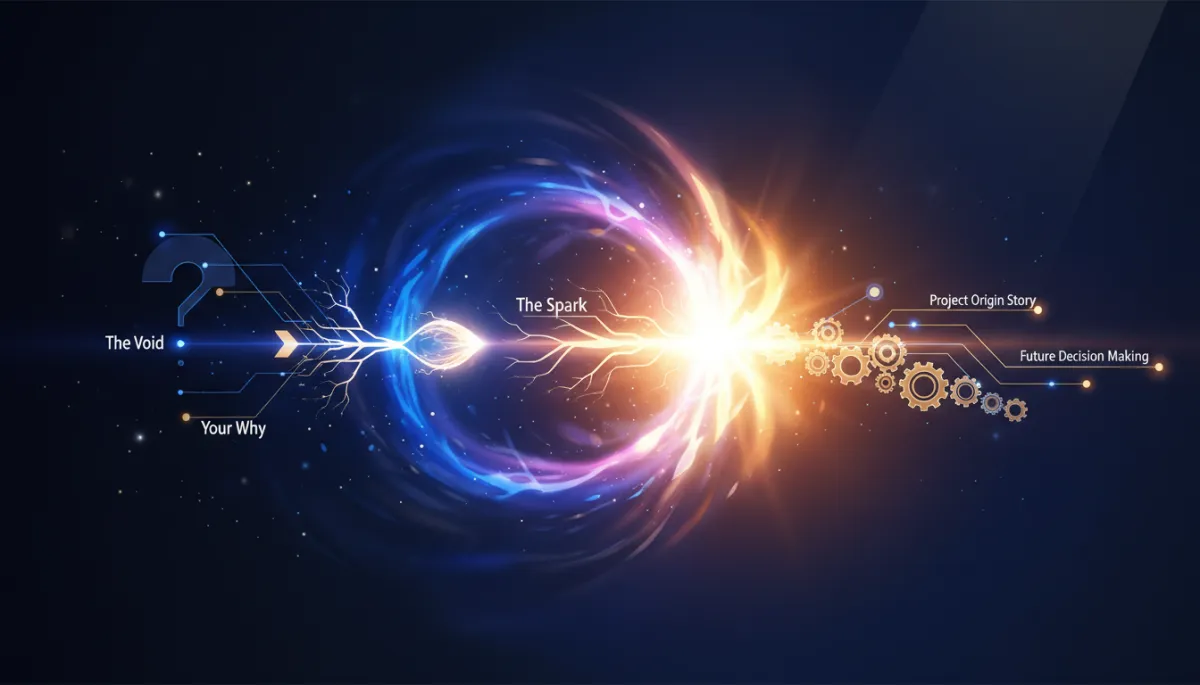
Every meaningful project, whether it is a business, a creative pursuit, or a deeply personal transformation, begins with a feeling: something is missing, and something wants to be born. That tension between absence and possibility is what this article calls The Void and The Spark. Understanding this tension is the heart of your Foundational Vision, the clear “why” that anchors your journey and guides every future decision you make.
The Void and the Spark: Naming the Moment Before the Beginning
Before your project had a name, a logo, or a plan, there was a quieter moment. Maybe it showed up as frustration with the way things are, a sense of emptiness in your daily routine, or a persistent whisper that you are meant to build something more. That is The Void—the space where you recognize a gap between the life you are living and the life you want to create. It is not just dissatisfaction; it is awareness. You are starting to see what is missing with uncomfortable clarity.
Then, something shifts. A conversation, a book, a late-night thought, or a moment of stillness ignites a new possibility. You realize, “I could build this. I could change this. I could be the one to start.” That is The Spark—the first flicker of direction in the darkness. The Spark does not solve everything; it simply points forward. Together, The Void and The Spark create the emotional and psychological foundation of your Project Origin Story, the deep human story behind what you are trying to build or become.
📌 Key Takeaway: The Void is what you can no longer ignore; The Spark is what you now feel compelled to create. Your Foundational Vision lives exactly where those two meet.
Why Your Foundational Vision Matters More Than Your Plan
It is tempting to jump straight into strategy: timelines, tools, business models, content calendars, or personal goals. But without a clearly articulated Foundational Vision, even the best plan will feel hollow and fragile. Your Foundational Vision is the deeper narrative that answers, in plain language, “Why does this project deserve to exist?” and “Why does it matter to me?” It is not a slogan; it is a compass. When you Define Your Why, you give your project a stable core that does not change every time circumstances do.
Plans will evolve. Markets will shift. Your skills will grow. But your Vision and Purpose—the underlying reason you chose this path—should remain recognizable even years later. That is the power of a strong Project Origin Story. It is not just a nice narrative for a website “About” page; it becomes the internal story you return to when you are tired, discouraged, or tempted to abandon what you started. In those moments, remembering The Void that pushed you and The Spark that called you forward can be the difference between quitting and recommitting.
💡 Pro Tip: If you feel stuck or unmotivated, do not start by rewriting your goals. Revisit your Foundational Vision and ask whether you are still honoring the original “why” behind your project.
Step 1: Define Your Why by Exploring The Void
To Define Your Why, start by getting honest about The Void. Instead of rushing to the inspirational part of your story, spend time with what was missing. Ask yourself:
What was I tired of tolerating in my life, work, or community?
What problem kept showing up that I could no longer ignore?
When did I first feel that something was off, misaligned, or missing?
The answers to these questions form the emotional roots of your Project Origin Story. Maybe you felt invisible in your career and started a project to amplify your voice. Maybe you were burned out by shallow work and wanted to create something with depth. Maybe you could not find the kind of community, service, or product you needed, so you decided to build it yourself. Whatever the specifics, The Void is personal. It is about where your lived experience collided with your values and exposed a painful mismatch between what is and what could be.
Do not sanitize this part of your story. A strong Foundational Vision is not built on vague positivity; it is built on clear awareness. When you can describe The Void with honesty—“I was exhausted by meaningless tasks,” “I felt disconnected from my own creativity,” “I saw people hurting without support”—you create a grounded starting point. From there, your Vision and Purpose can grow in a way that is both inspiring and real.
Step 2: Capture The Spark That Turned Awareness into Action
If The Void is the ache, The Spark is the idea that made you say, “I am going to do something about this.” To fully articulate your Foundational Vision, you need to name that turning point. Ask yourself:
What specific moment or insight inspired me to start this project?
What did I realize about myself, my skills, or my responsibility?
What was the first clear idea, phrase, or image that made the project feel real?
The Spark might have been small: a journal entry, a sketch, a voice note, a single sentence you wrote in frustration. Or it might have been dramatic: a crisis, a big decision, a moment when you walked away from an old path. Either way, this is where your Vision and Purpose begin to take shape. You are no longer only aware of what is wrong; you are seeing what might be possible if you commit to change. The Spark is the seed of your Foundational Vision—the earliest version of the future you are now working toward.

The moment you write down your spark, your project shifts from idea to intent.
Weaving The Void and The Spark into a Coherent Project Origin Story
Once you have explored both The Void and The Spark, you can begin to craft a coherent Project Origin Story. This is not about embellishment; it is about clarity. A simple structure you can use is:
Before: Describe the situation you were in and the Void you felt.
Shift: Share the moment or realization that became your Spark.
Commitment: Explain the decision you made and what you are now determined to create.
For example: “After years of feeling drained by work that never aligned with my values, I realized I was slowly disconnecting from my own creativity. That was The Void. One evening, after yet another day of going through the motions, I wrote a single sentence in my notebook: ‘I want to build something that actually helps people feel seen.’ That was The Spark. From that point forward, I committed to creating a project that uses storytelling to help individuals reconnect with their inner voice.” This kind of narrative is the living expression of your Foundational Vision.
📌 Key Takeaway: Your Project Origin Story does not need to be dramatic; it needs to be honest. Authenticity is what turns your Vision and Purpose into a reliable guide for Future Decision Making.
How a Strong Origin Story Anchors Every Future Decision
When you clearly articulate The Void and The Spark behind your project, you are doing more than telling a story; you are building a decision-making framework. Your Foundational Vision becomes a filter for Future Decision Making. Instead of asking, “Is this opportunity impressive?” you can ask, “Does this opportunity move me closer to the world my Vision and Purpose describe?” Instead of, “Should I pivot because this is hard?” you can ask, “Does the original Void still matter to me, and is my Spark still alive?”
Here are some practical ways your Project Origin Story can guide your choices:
Scope decisions: When new ideas appear, you can ask whether they deepen your core Vision and Purpose or dilute it. If an idea does not address The Void you set out to solve, it may be a distraction, not a direction.
Values alignment: Your Foundational Vision can help you say “no” to partnerships, clients, or strategies that conflict with your “why,” even if they look profitable or popular from the outside.
Resilience in setbacks: When a launch fails, a project stalls, or progress feels slow, you can reconnect with your Project Origin Story and remember that you did not start just for quick wins. You started to respond to a real Void with a meaningful Spark.
Over time, this alignment between your Foundational Vision and your decisions creates integrity. People can feel when your actions are consistent with your story. You are not just talking about Vision and Purpose; you are living them. That consistency builds trust—with yourself first, and then with anyone who encounters your work.
Turning Vision and Purpose into Daily Practice
A powerful Foundational Vision is not meant to sit in a document or on a website page. It is meant to shape your daily choices. To make that happen, you can translate your Project Origin Story into simple practices that keep The Void and The Spark visible in your everyday life. For example:
Start your week by rereading a paragraph that captures your “why” and asking, “What one action can I take this week that honors this Vision and Purpose?”
When faced with a tough decision, write down both options and note which one feels more aligned with the project you originally set out to build.
At the end of each month, reflect on where you drifted away from your Foundational Vision and how you can gently correct course.
These small rituals keep your Project Origin Story alive. They remind you that your project is not just a collection of tasks; it is an ongoing response to The Void you once felt and the Spark you chose to follow. In this way, Future Decision Making becomes less about guessing and more about returning to what you already know is true about why you started.
When Your Void Evolves and Your Spark Changes Shape
Projects, like people, grow. Over time, the Void that originally motivated you may soften or transform. Perhaps you have already solved part of the problem you set out to address. Perhaps your own life circumstances have changed. This does not mean your Foundational Vision was wrong; it means your understanding of it is deepening. The invitation is to periodically revisit The Void and The Spark and ask:
What part of my original Void has been healed, and what new gaps am I noticing now?
How has my Spark evolved as I have gained experience, skills, and perspective?
If I were to restate my Foundational Vision today, what would remain the same, and what would I refine?
This kind of reflection allows your Project Origin Story to stay alive without losing its core. You are not rewriting your history; you are updating your understanding of it. The central “why” can remain intact—“I want to help people feel less alone,” “I want to bring more honesty into this industry,” “I want to live in alignment with my creativity”—even as the specific expression of that why shifts over time. In this way, your Foundational Vision remains a steady reference point for Future Decision Making, even as the details evolve.
A Simple Exercise to Clarify Your Foundational Vision Today
To bring all of this together, set aside fifteen to twenty minutes and complete this exercise to clarify your own Foundational Vision around The Void and The Spark:
Write about The Void: In one paragraph, describe the situation, feeling, or problem that made you realize something had to change. Be specific and honest. Use concrete examples from your life or work.
Describe The Spark: In a second paragraph, capture the moment or idea that inspired you to start your project. What did you see, read, hear, or feel that lit the first flame of your Vision and Purpose?
State your commitment: In a third paragraph, complete this sentence: “Because of what I experienced in The Void, and because of the Spark I felt, I am committed to creating…” Then describe, in your own words, the impact you want your project to have.
When you are done, you will have a clear, personal Project Origin Story that weaves together The Void and The Spark into a living statement of your Vision and Purpose. This document can sit on your desk, inside your notebook, or as a note on your phone—a quiet anchor you can return to whenever you need to remember why you started.
Bringing It All Together: The Void, The Spark, and Your Next Step
At its core, The Void and The Spark is a simple but powerful lens for understanding your own journey. The Void reminds you that your project did not appear out of nowhere; it emerged from real needs, real frustrations, and real desires for change. The Spark reminds you that you are not just reacting to what is wrong; you are actively choosing to create something better. Together, they form the emotional and narrative backbone of your Foundational Vision.
When you consciously Define Your Why, you are not just writing nice words. You are building a personal compass for Future Decision Making. You are giving yourself a way to navigate uncertainty, evaluate opportunities, and stay aligned with the deeper Vision and Purpose that brought you here in the first place. That is what makes a strong Project Origin Story so valuable—it does not only explain your past; it quietly shapes your future.
Your next step is simple: carve out a little time to sit with your own Void and Spark. Write them down. Speak them out loud. Share them with someone you trust. Let your Foundational Vision move from a vague feeling to a clear, grounded story. From there, every action you take can become an expression of that story—one decision, one project, one brave step at a time.