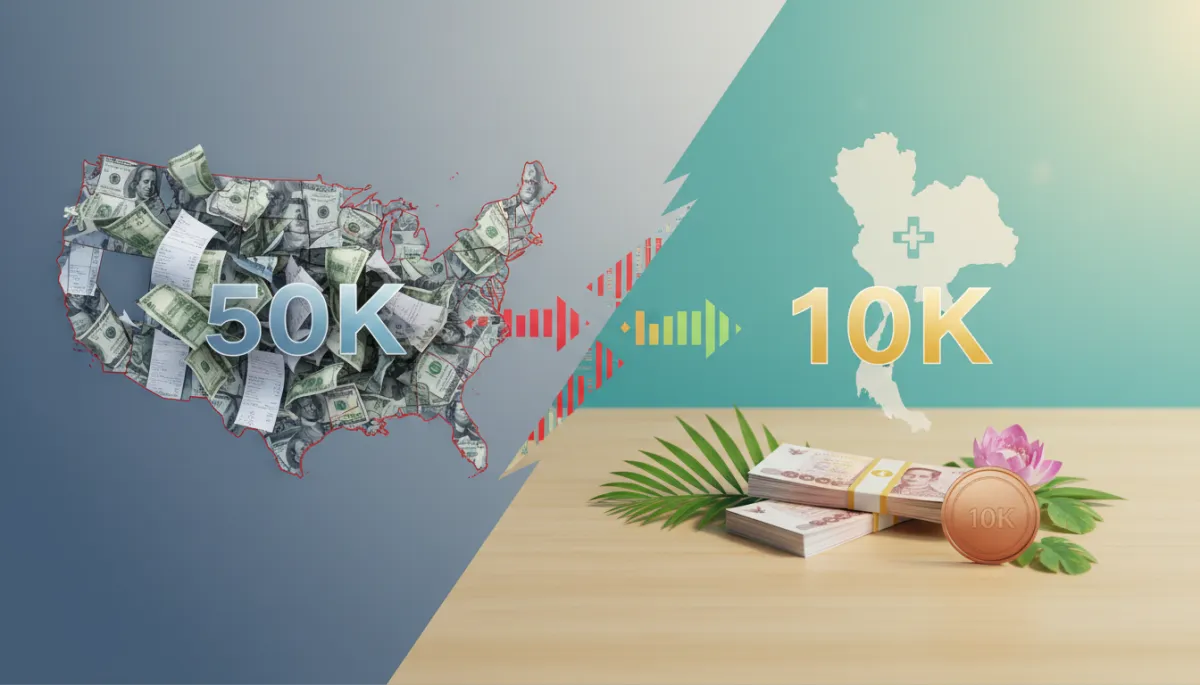
US vs. Phuket: Health Cost Comparison
Health Costs, US Healthcare, Phuket Medical Expenses, Cost Comparison
Cost Comparison: I Spent $50k on Health in the US vs. $10k in Phuket
What happens when you take the same health needs, the same person, and split their care between the United States and Phuket, Thailand? The answer is a brutal lesson in Health Costs, Quality Of Care, and how much you can save by being willing to travel for treatment. This is a practical, numbers‑driven Cost Comparison aimed at individuals trying to stretch every healthcare dollar without sacrificing safety or outcomes.
The Scenario: Same Health Year, Two Very Different Bills
Imagine you are a 40‑something professional with a fairly typical “busy adult” health year:
One emergency room visit for severe abdominal pain that turns out to be appendicitis
Surgery (appendectomy) and a short hospital stay with one night in ICU for monitoring
A couple of follow‑up specialist visits, blood work, and imaging (including an MRI)
A general annual health check and some routine prescriptions
In the US, that year ends up costing around $50,000 in total health spending once you combine premiums, deductibles, co‑pays, and out‑of‑pocket bills. In Phuket, for a comparable set of services at reputable hospitals, you land closer to $10,000—including flights and accommodation. The gap isn’t a rounding error; it’s a life‑changing difference in Health Travel Savings.
Step 1: Understanding US Healthcare Costs for an Ordinary Individual
To make this Cost Comparison real, start with what many Americans already pay just to have coverage. In 2024, national health spending reached about $5.3 trillion, or roughly $15,474 per person, and it’s still climbing at over 5% per year. Employer‑sponsored plans are projected to cost more than $18,500 per employee in 2026, according to Mercer, with increases as high as 9.6% in some forecasts.
If you are buying your own insurance on the ACA marketplace, the average Silver plan premium is estimated around $752 per month in 2026—before you even see a doctor. That’s more than $9,000 a year, and many people still carry deductibles of $5,000–$8,000 on top of that. When subsidies phase out, some enrollees see premiums shoot up by over 100%, leaving them paying more for coverage than for rent or food.
📌 Key Takeaway: In the US, you can easily spend five figures per year on US Healthcare before a major medical event even happens. That’s your baseline.
Step 2: The $50,000 US Health Year – Where the Money Actually Goes
Let’s break down a realistic $50,000 year in the United States for one insured individual:
Expense Category (US) Typical Cost (USD) Annual insurance premiums (individual ACA Silver plan) $9,000–$10,000 Deductible + co‑insurance for major event (ER + surgery) $7,000–$10,000 Hospital charges (appendectomy, 3‑day stay, ICU night) $25,000–$30,000 (billed; portions negotiated but often partly owed) Imaging (CT scan, MRI), blood work, follow‑up visits $4,000–$6,000 Medications, physical therapy, miscellaneous $2,000–$4,000
Add it up and you’re in the $47,000–$60,000 range for one complicated but not catastrophic year. These are plausible figures in the context of US Healthcare, especially when you factor in surprise bills, out‑of‑network providers, and charges that insurers only partially cover. It’s no wonder surveys show millions of Americans skipping meals or cutting back on essentials just to keep up with Health Costs.
Step 3: Phuket Medical Expenses for the Same Health Needs
Now, move the same individual to Phuket for that health year. Phuket is a major medical tourism hub with modern private hospitals like Bangkok Hospital Phuket and Siriroj, as well as public options like Vachira. Prices are transparent, and you pay per service, so you can see exactly what your Phuket Medical Expenses look like.
Service (Phuket – private hospital) Typical Price (THB) Approx. USD (at 35 THB = $1) GP / ER initial consultation 2,000–5,000 THB ~$60–$145 Specialist consultations (several visits) 1,200–3,000 THB each ~$35–$85 each Blood panels, X‑ray, CT scan, MRI combined 25,000–60,000 THB ~$715–$1,715 Appendectomy (Bangkok Hospital level) 80,000–150,000 THB ~$2,285–$4,285 3‑night hospital stay + 1 night ICU 40,000–90,000 THB ~$1,145–$2,570 Medications, follow‑ups, annual check‑up 20,000–40,000 THB ~$570–$1,145
Even if you choose top‑tier international hospitals, your total Phuket Medical Expenses for this entire episode of care might land around $6,000–$9,000. Add a comprehensive international insurance plan (say, 50,000–80,000 THB per year, or roughly $1,400–$2,300), plus flights and a month of accommodation, and you’re still hovering around $10,000–$12,000 in total Health Costs for the year.

Transparent pricing in Phuket hospitals makes planning medical travel far less stressful.
The Stark Financial Breakdown: $50,000 vs. $10,000
Put side by side, the disparity in Health Costs becomes hard to ignore:
Category US Healthcare (USD) Phuket (USD, incl. travel) Annual coverage / insurance ~$9,500 ~$1,800 (international plan) Surgery + hospital stay ~$30,000 billed (portion out‑of‑pocket) ~$5,500 (self‑pay package) Imaging, labs, follow‑ups ~$5,000 ~$1,500 Medications, extras ~$3,000 ~$700 Flights + 1 month lodging $0 (stayed in US) ~$1,500–$2,000
Even with generous assumptions for Phuket, you’re still looking at roughly $50,000 in the US vs. $10,000–$12,000 in Phuket. That’s a 4–5x difference for comparable outcomes. For an individual, that gap can equal:
A down payment on a home
Several years of retirement savings
A college fund boost or debt payoff
💡 Pro Tip: When you calculate Health Travel Savings, don’t just compare procedure prices. Add premiums, deductibles, and the real opportunity cost of tying up $40,000+ in medical bills.
But What About Quality Of Care?
Cost is only half of a meaningful Cost Comparison. The natural question is: are you sacrificing Quality Of Care by going to Phuket instead of staying in a US hospital?
The United States undeniably leads in cutting‑edge research, complex surgeries, and specialized care at world‑class centers. For rare diseases, advanced oncology, or experimental treatments, top US hospitals still set the benchmark. But for many routine and mid‑complexity procedures— orthopedics, dental work, general surgery, cosmetic procedures, and check‑ups—Phuket’s private hospitals are highly competitive.
International standards: Major hospitals in Phuket are geared toward medical tourists, often with international accreditation, English‑speaking staff, and modern equipment.
Time with doctors: Consultations can be longer and more personal because clinicians aren’t squeezed by the same insurance‑driven time pressures you see in US Healthcare.
Comfort and recovery: Private rooms, attentive nursing, and a calmer environment can make recovery less stressful than in a busy US hospital.
The trade‑offs? Phuket’s public hospitals can be crowded, and highly specialized care may require travel to Bangkok or another major city. Language barriers can exist outside of international facilities. But for planned procedures and diagnostics, many individuals find that Phuket delivers equal or better Quality Of Care for a fraction of the price.
Who Does This Strategy Make Sense For?
Health travel isn’t only for retirees or the ultra‑wealthy. Individuals in several situations can benefit from planning care in Phuket:
Self‑employed professionals facing steep ACA premiums and high deductibles who want predictable, transparent Phuket Medical Expenses.
Digital nomads and remote workers who can base themselves in Thailand for months and combine lifestyle with Health Travel Savings.
Uninsured or under‑insured Americans staring down five‑figure quotes for dental work, orthopedic surgery, or imaging in the US.
Early retirees who are not yet on Medicare and need to control Health Costs between 50 and 65.
⚠️ Warning: Emergency situations—heart attacks, major trauma, strokes—are usually not the right time to get on a plane. Health travel works best for planned procedures, diagnostics, and chronic condition management.
How to Evaluate If Phuket Is Right for Your Care
If you’re considering shifting part of your care from the West to Asia, approach it like any major financial decision. Here’s a simple framework:
Get detailed quotes in both locations. Ask your US provider for cost estimates, and contact Phuket hospitals for package prices. Many have medical tourism coordinators who respond in English and outline Phuket Medical Expenses clearly.
Include all travel costs. Add flights, hotels or apartments, visas, local transport, and food. Even with these, the Health Travel Savings can remain dramatic.
Check accreditation and doctor credentials. Look for internationally accredited hospitals, read reviews from other patients, and verify that your doctor is experienced with your condition.
Assess follow‑up care. Can you do virtual follow‑ups? Will your local doctor in the US coordinate with your Phuket surgeon or specialist? Plan this before you book anything.
Be honest about your risk tolerance. If you have complex comorbidities, you may prefer to stay close to a major US academic center. For otherwise healthy individuals, Phuket can be a very reasonable option.
The Bigger Picture: What This Cost Comparison Really Tells You
When you zoom out, the $50,000 vs. $10,000 comparison is about more than one person and one surgery. It highlights a structural reality: US Healthcare is consuming close to 20% of the entire economy, and yet many individuals still struggle to access basic services without financial strain. In contrast, countries like Thailand have built a parallel ecosystem where international patients can receive solid Quality Of Care at a fraction of Western prices.
For you as an individual, the takeaway is empowering: you are not locked into the prices of your home country. With planning, research, and a bit of flexibility, you can arbitrage global Health Costs in your favor—protecting both your health and your net worth.
Final Thoughts: Turning Health Travel Savings into Life Upgrades
If you spent $50,000 on care in the US this year, you might walk away with good treatment—but also with drained savings, new debt, or years of financial catch‑up. If you spent $10,000 in Phuket for comparable care, you could redirect the remaining $40,000 toward building the life you actually want: paying off loans, investing, traveling for pleasure instead of necessity, or simply buying yourself peace of mind.
No healthcare system is perfect, and medical travel is not a magic bullet. But the numbers are too stark to ignore. For many individuals, especially those squeezed by rising Health Costs in the West, exploring Phuket Medical Expenses is not just an exotic idea—it’s a rational, financially sound strategy. The choice is no longer between health and money. With careful planning, you can have both.